
In conversation with leading 20th century architect, John Outram, described by the Barbican as “one of Britain’s most singular and adventurous architects”.
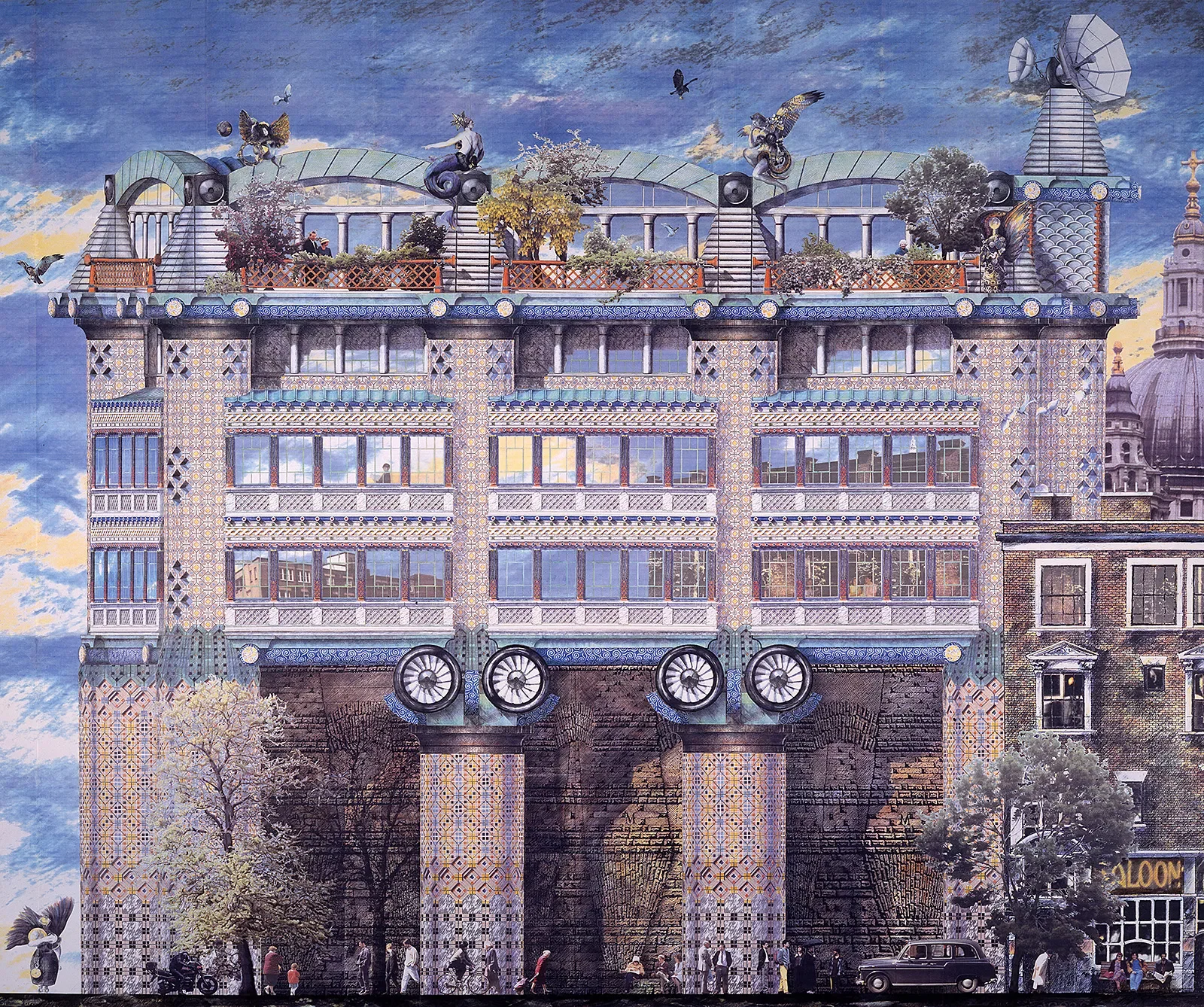
John Outram, Project for 200 Victoria Street for Rosehaugh- Stanhope Developers (unbuilt), 1988-90. Credit: John Outram.
In a fictional fable written by Outram in the summer of 1986, a nameless protagonist dreams of a life that honours both body and mind. It is a luxurious life, not in the sense of palatial opulence and pampering, but in the classical sense — what Hannah Arendt once termed the vita activa and the vita contemplativa — a life in which public engagement and private contemplation are not divorced, but as one.
The story’s refrain, “You’re all mud and I’m all marble,” is a nursery rhyme bemoaning a split civilisation: one that builds dull boxes for the masses and reserves real ideas for the few. This schism between purpose and poetry, mind and machine, is what Outram spent a career trying to bridge. Not through nostalgia, but through radical architectural symbolism, esoteric ornamentation, and an unflinching belief that buildings could be modern temples. Not so much in the contemporary sense of pantheons to personal (or impersonal) taste but to cosmic ideas.
“Luxury has not changed for me,” Outram told me recently, at 91, “but the imperative has. For that has always been military.”
There it is — the sudden pivot from poetry to power that defines his worldview. Coming of age, under the twin shadows of declining empire and simmering Cold War, Outram’s architecture never forgets the geopolitical substrate that underpins architectural movements. The rise of machines, the enclosure of land, the religious and ontological reshufflings that define eras— all were preconditions to what he sees as a new kind of warfare: aesthetic, symbolic, philosophical, and intellectual. Modern luxury architecture, in his view, is a battleground and a temple, a site where meaning is either annihilated or reborn.
And yet, much of today’s luxury architecture remains bland. Austerely tasteful, vaguely international, polished to the point of erasure. Why? Perhaps, Outram suggests, because we’ve forgotten how to read buildings. “Even lovers of architecture are unable to ‘read’ the meanings built into the Old City” he says. The Old City refers to London’s buildings that survived the Blitz and stand untainted by what he calls “the mind-rot of Modernism” which replaced the bombed out buildings. A hasty flattening of symbolism and sterilisation of spiritual and civic imagination that he railed against during his career.
Despite Outram’s yearning to inject London with polychromatic symbolism, many of his most intellectually ambitious commissions took place outside of the capital, in places like East Sussex, where Marit Rausing (of the Tetra Pak dynasty) built her own philosophical villa. “She told me, John, when you have our sort of money you must aim for the best.’” And by best, she didn’t mean gold everything, she meant metaphysical architecture.
Marit quoted Baudelaire as the red steel frame of her future house, rose into the Sussex air. “Continentals,” Outram muses, “are more intellectual than Brits.” He may be half-joking, but he’s adamant that Britain’s post-war taste culture has not encouraged architectural literacy compared to continental traditions which he believes prize the presence of architects and artists as contributors to civic imagination.
Still, his clients, from Marit Rausing to Henrietta McCall, were often figures of wealth and deep curiosity. Their commissions may have been lavish but they didn’t see the creations as pure indulgence; they were in many ways spatial thought experiments. Henrietta’s house, Sphinx Hill, drew on her obsession with ancient Egypt, producing a postmodern temple on the Thames.
Outram refers to these homes as a kind of philosophical luxury: a rare convergence of resources, intellectual will, and symbolic ambition. “Perhaps the grander the client, the grander their ideas,” I say, though we acknowledge this doesn’t always hold. Plenty of the ultra-wealthy settle for tasteful anonymity. What distinguishes clients like Rausing is a desire not just to possess luxury, but to participate in its creation, to shape the cultural codes that luxury expresses.
Which returns to Outram’s point about power: luxury has always been political. From Versailles to Buckingham Palace, from Outram’s Wadhurst to Donald Trump’s $200 million neo-classical ballroom, architecture functions not just as shelter or status, but as a vessel for ideology. Along with books, architectural monuments are one of the first cultural vestiges to be destroyed for the potency they contain.
Outram argues for the reintroduction of a chapter on military architecture, to equip architects to design urban dwellings that are physically adaptive in a new era of technological warfare. In his mind, luxury in an era of postcode drones is for humanity to “first learn how to enjoy living in pleasant and secure ‘cities’”. That is to adapt to the realities we find ourselves in so that we may find oases of peace. Only then, he believes, can we meaningfully explore what he views as ‘real luxury’, that is the time and space to explore artistic forms that must be decoded or learned. Forms that flower through contemplation.
So what remains of luxury when its forms are either drained of meaning or caught between global power struggles? And what becomes of our capacity for contemplation when we are too guarded, or too busy, to sustain it? Outram’s esoteric work, destroyed, debated, lauded, and resurrected, suggests it’s not the physical materials that matter most, but the intangible meanings and ideas they contain. The capacity to stretch the mind and linger in our consciousness. In a culture that increasingly values speed, surface and efficiency, his dazzling imagination reminds us that real power, the kind that outlasts fashions, dynasties, and even ancient buildings, resides in the ideas and ideals we pass down.
